Milam County Historical Commission
Milam County, Texas
Milam County, Texas



All articles from the Temple Daily Telegram are published with the permission of the
Temple Daily Telegram.
All credit for this article goes to
Jeanne Williams and the Temple Daily Telegram
Temple Daily Telegram.
All credit for this article goes to
Jeanne Williams and the Temple Daily Telegram
Reclaiming Their Legacy
Jeanne Williams
Temple Daily Telegram - October 25, 2010
Alumni seek to restore historic school in Davilla
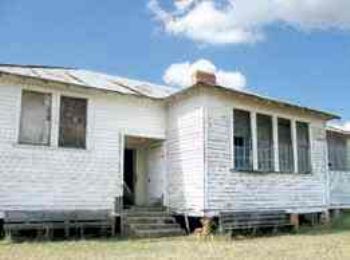
Davilla - On paper it was Floor Plan No. 20, a “Two Teacher Community School” that must
face “east or west only.” When the building materialized, the landscape boasted a new,
plain white-frame, pier-and-beam structure standing well off the ground that contained
two small vestibules, two adjoining classrooms with identical cloak rooms, and an
industrial room.
For 27 years, from 1921 to 1948, this building proudly served as the educational
centerpiece for 60-plus black students from first to 10th grade and was a gathering place
of the African-American community living in the agricultural setting 18 miles west of
Cameron.
Today at age 89, its white paint is chipped, concrete steps show wear and tear, the
ceiling has fallen in and wood floors are treacherous to tread on after rainwater leaked
through a storm-damaged roof. This old building stands passively in retirement, removed
from the crossroads in downtown Davilla, at ease in its role as an abandoned school
house.
In the near future, the Davilla school for blacks will be taking on a new assignment, as
a treasured memento from the past worthy of a National Register of Historic Places
listing and as an interactive children’s museum where today’s students will be allowed to
experience the era of multi-grades crammed into one or two classrooms often taught by one
teacher.
Davilla School for blacks educated its charges in two adjoining school rooms, and many of
the teachers were husband-and-wife teams. The atmosphere was family-like, recalled former
student Wilma Green, who attended school through the 10th grade, and graduated from O.J.
Thomas High School in Cameron, as did her sister, Darlene Burleson.
“We saw everybody at school and we would go to church and see everybody all over again,”
Mrs. Green said.
On a recent visit to their childhood “stomping grounds” Mrs. Green, Arline Gadison and
Mrs. Burleson recalled happy times at school; the Christmas and Easter pageants, for
which their mothers made them fancy dresses with ruffles; the playground games; and the
delicious school lunches prepared by a beloved teacher, Mrs. Batts, “who sure could
cook.”
The years have not erased memories of the names of teachers who served the students.
“Most of us were family,” said Mrs. Gadison, whose home sits in front of the Rosenwald
school property. “The best time was when they had the entertainment. We had the cake
walks, and if you get on the right number you would go to heaven; if you stood on other
numbers you would go to hell. My sister cried because she got on the wrong number and
thought she was going to go to hell. Those were good times. We always had a record player
and the kids danced.”
Mrs. Green said, “We want to bring some of those good times back.”
“We were educated, too,” said Mrs. Burleson with emphasis. “We got a good education. We
had tough teachers and they meant business.”
The women agreed that one goal is to establish “a place to come and visit with our
families and our friends and the community.”
“This is something that we grew up with, and we want to keep it,” Mrs. Green said.
Mrs. Gadison added, “We used to have homecomings, that’s what we hope to get back to and
the families will come back.”
“And we know our mothers and fathers would want that,” Mrs. Burleson said, adding that
future generations would benefit from the unique heritage offered by Davilla’s Rosenwald
School.
Davilla’s school for black children was one of 464 educational buildings built in Texas
from 1920 to 1930 by the Julius Rosen wald Fund, a charity established by the Chicago
philanthropist who was the president of Sears and Roebuck Co.
Rosenwald was one of several wealthy whites who took an interest in the educational needs
of Southern, rural African-Americans, the Texas Historical Commission reported. Schools
were built free in various communities, but designs were strictly followed for one-
teacher or two-teacher types facing east or west, or a six-teacher layout that faced
north or south.
By the time of Rosenwald’s death in 1932, some 4,977 schools had been built throughout
the South. Texas ranks third in the total number of schoolhouses built. Many Rosenwald-
built institutions continued teaching until the mid-1960s, when public schools
desegregated.
The Hill, Fontaine and Shelby Association — composed of the only descendants still living
in the site of Davilla’s Freedom Co - lony, established when slavery was abolished — are
seeking grants to fund total restoration and re-establish the school as a museum,
association member Micheal E.P. Davis said. The three families maintain the school
property and the cemetery for blacks in Davilla.
The Hill-Fontaine-Shelby family originated in 1856 when Dan Shelby married Harriett
Carpenter. The couple and their six children, Rachel Shelby-Hill, Susie Shelby Fontaine,
John Shelby, Will Shelby, Tucker Shelby and Sally Shelby Brown, were among the many
blacks who lived in the Freedom Colony in Davilla, and many of their descendents were
educated at the Rosenwald school.
The Davilla Rosenwald School was the first “real school building” available to black
students, according to a history provided by the Hill, Fontaine and Shelby Association.
The school closed its doors in 1948, was abandoned and fell into disrepair until its
recognition, identification and verification as a Rosenwald School in 2007
As of today, there are more than 80 Davilla school alumni identified, and research is
underway to find families of others who attended the school.
The Hill, Fontaine and Shelby Association is dedicated to capturing stories of students
who attended the school and the family members who supported the school “because they fit
into the mosaic of a unique time of a story almost forgotten.”
jwilliams@tdtnews.com
Photos by Shirley Williams
Left photo: Abandoned as a school in 1948, this three-room soon will have a new teaching assignment as a historical site on the black experience in Texas, and as an interactive museum for visitors to experience learning as their forebears did in basic accommodations that taught the first thru tenth grades.
Right photo:
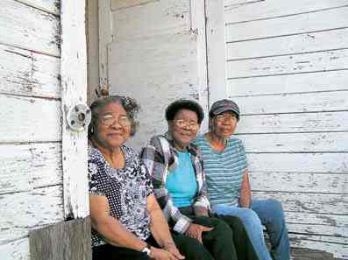
Three alumni for Davilla's Rosenwald school reminisce about their times as scholars at the three room campus. They recalled beloved teachers, remembered a cafeteria that spooned up fabulous lunches, and laughed at memories of activities and events. Seated on the school's front steps are Darlene Burleson (left), Wilmer Green and Arline Gadison.
.
Right photo:
Three alumni for Davilla's Rosenwald school reminisce about their times as scholars at the three room campus. They recalled beloved teachers, remembered a cafeteria that spooned up fabulous lunches, and laughed at memories of activities and events. Seated on the school's front steps are Darlene Burleson (left), Wilmer Green and Arline Gadison.
.