

In Texas, a city or a county government which has been designated
as a Certified Local Government (CLG) must:
1. Enforce state or local legislation that protects
historic properties
2. Establish a qualified review commission composed of
professional and lay members
3. Maintain a system for surveying and inventorying
historic properties
4. Provide for public participation in the historic
preservation process, including recommending properties
to the National Register of Historic Places.
The Certified Local Government Program is a preservation partnership between local,
state and national governments focused on promoting historic preservation at the grass
roots level. The program is jointly administered by the National Park Service (NPS)
and the State Historic Preservation Offices (SHPOs) in each state, with each local
community working through a certification process to become recognized as a Certified
Local Government (CLG). CLGs then become an active partner in the Federal Historic
Preservation Program and the opportunities it provides.
Why become a CLG? There are many reasons, but the key reason is the access
certification provides to the expert technical advice of the State Offices as well as
the NPS. Partnerships with the National Alliance of Preservation Commissions, Preserve
America, the National Trust for Historic Preservation, and the National Main Street
Center are also networks that CLGs have an opportunity to tap into. Of course, access
to Federal funding is another benefit, making certified communities able to access the
portion of Federal funds set aside by each SHPO for just CLGs annually. Being a CLG
also shows your community's commitment to keeping what is significant from the past
for future generations. As a certified town, city, or county seeking other
opportunities, it becomes easy to demonstrate a readiness to take on a preservation
project and be successful.
Milam County Historical Commission
Milam County, Texas
Milam County, Texas
Meetings
2016-09-29 - Lucy Hill Patterson Memorial Library - 5:30 PM
.
Certified Local Government
Appointed to the 2013-2014 Certified Local Government Board by County Judge Dave Barkemeyer:
Joy Graham, Dr. Lucile Estell, Darlene Anglen, Geri Burnett, Mary Nell Neely, Lisa Benford, William Beene, Judith Slusher, Toby Johnson, Doug Williams and Johnnielyn Brown.
Joy Graham, Dr. Lucile Estell, Darlene Anglen, Geri Burnett, Mary Nell Neely, Lisa Benford, William Beene, Judith Slusher, Toby Johnson, Doug Williams and Johnnielyn Brown.
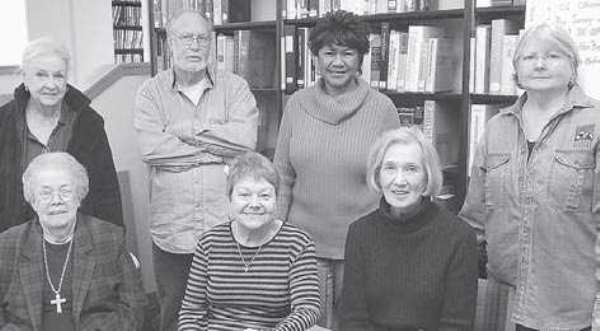
2014 CLG COMMITTEE—The Milam County Certified Local Government Committee met recently at the city library. Discussion was over the committee’s historical survey for Milam County which is due to be updated this year. Committee members present included (seated, L-R) Dr. Lucile Estell, Geri Burnett, Joy Graham; standing, Toby Johnson, William Beene, Lisa Benford and Beth Brooks.
Rockdale Reporter - 2014-02-05
Rockdale Reporter - 2014-02-05
Photo courtesy of Jack Brooks
2017-2018 Members
Geri Burnett, Chair; James Brymer; Patricia Brymer; John Pruett; Brenda Pruett; Mary Neely; Darlene Anglen; Elaine Baumann; Elissa Benford; Lucille Estell; Zane Stigall.
2016-2017 Members:
Geri Burnett, Chair; James Brymer; Patricia Brymer; John Pruett; Brenda Pruett; Mary Neely; Darlene Anglen; Elaine Baumann; Johnnielyn Brown; Elissa Benford; Judy Slusher.
Geri Burnett, Chair; James Brymer; Patricia Brymer; John Pruett; Brenda Pruett; Mary Neely; Darlene Anglen; Elaine Baumann; Elissa Benford; Lucille Estell; Zane Stigall.
2016-2017 Members:
Geri Burnett, Chair; James Brymer; Patricia Brymer; John Pruett; Brenda Pruett; Mary Neely; Darlene Anglen; Elaine Baumann; Johnnielyn Brown; Elissa Benford; Judy Slusher.